
A Micrograin BSDF Model for the Rendering of Porous Layers
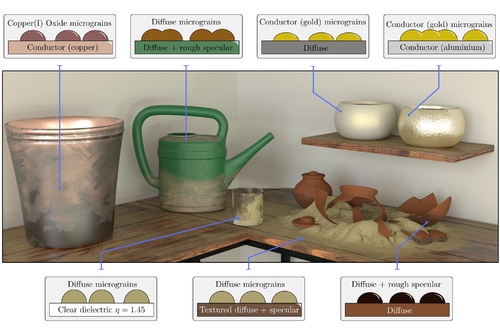
DescriptionWe introduce a new BSDF model for the rendering of porous layers, as found on surfaces covered by dust, rust, dirt, or sprayed paint.
Our approach is based on a distribution of elliptical opaque micrograins, extending the Trowbridge-Reitz (GGX) distribution [Trowbridge1975,Walter2007] to handle pores (i.e., spaces between micrograins).
We use distance field statistics to derive the corresponding Normal Distribution Function (NDF) and Geometric Attenuation Factor (GAF), as well as a view- and light-dependent filling factor to blend between the porous and base layers.
All the derived terms show excellent agreement when compared against numerical simulations.
Our approach has several advantages compared to previous work [Merillou2000,Wang2022,dEon2023].
First, it decouples structural and reflectance parameters, leading to an analytical single-scattering formula regardless of the choice of micrograin reflectance.
Second, we show that the classical texture maps (albedo, roughness, etc) used for spatially-varying material parameters are easily retargeted to work with our model.
Finally, the BRDF parameters of our model behave linearly, granting direct multi-scale rendering using classical mip mapping.
Our approach is based on a distribution of elliptical opaque micrograins, extending the Trowbridge-Reitz (GGX) distribution [Trowbridge1975,Walter2007] to handle pores (i.e., spaces between micrograins).
We use distance field statistics to derive the corresponding Normal Distribution Function (NDF) and Geometric Attenuation Factor (GAF), as well as a view- and light-dependent filling factor to blend between the porous and base layers.
All the derived terms show excellent agreement when compared against numerical simulations.
Our approach has several advantages compared to previous work [Merillou2000,Wang2022,dEon2023].
First, it decouples structural and reflectance parameters, leading to an analytical single-scattering formula regardless of the choice of micrograin reflectance.
Second, we show that the classical texture maps (albedo, roughness, etc) used for spatially-varying material parameters are easily retargeted to work with our model.
Finally, the BRDF parameters of our model behave linearly, granting direct multi-scale rendering using classical mip mapping.
Event Type
Technical Papers
TimeTuesday, 12 December 20239:30am - 12:45pm
LocationDarling Harbour Theatre, Level 2 (Convention Centre)