
The effect of display capabilities on the gloss consistency between real and virtual objects
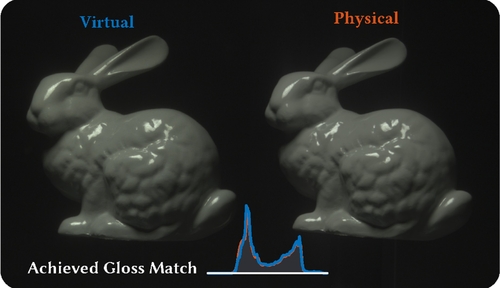
DescriptionA faithful reproduction of gloss is inherently difficult because of the limited dynamic range, peak luminance, and 3D capabilities of display devices. This work investigates how the display capabilities affect gloss appearance with respect to a real-world reference object. To this end, we employ an accurate imaging pipeline to achieve perceptual gloss match between a virtual and real object presented side-by-side on an augmented-reality high-dynamic-range (HDR) stereoscopic display, which has not been previously attained to this extent. Based on this precise gloss reproduction, we conduct a series of gloss matching experiments to study how gloss perception degrades based on individual factors: object albedo, display luminance, dynamic range, stereopsis, and tone-mapping operator. We support the study with a detailed analysis of individual factors, following by an in-depth discussion on the observed perceptual effects. Our experiments demonstrate that stereoscopic presentation has a limited effect on gloss matching task on our HDR display. However, both reduced peak luminance and dynamic range of the display reduce the perceived gloss. This means that the visual system cannot compensate for the changes in gloss appearance across luminance (lack of gloss constancy), and the tone mapping operator should be carefully selected when reproducing gloss on low dynamic range (LDR) display.
Authors


Event Type
Technical Papers
TimeTuesday, 12 December 20239:30am - 12:45pm
LocationDarling Harbour Theatre, Level 2 (Convention Centre)