
Progressive Shell Quasistatics for Unstructured Meshes
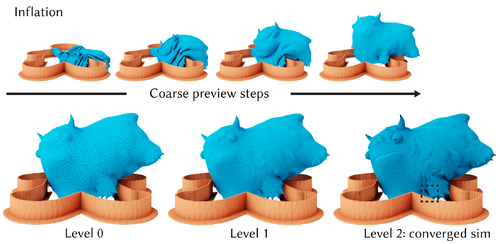
DescriptionThin shell structures exhibit complex behaviors critical for modeling and design across wide-ranging applications. To capture their mechanical response requires finely detailed, high-resolution meshes. Corresponding simulations for predicting equilibria with these meshes are expensive, whereas coarse-mesh simulations can be fast but generate unacceptable artifacts and inaccuracies. The recently proposed progressive simulation framework [Zhang et al. 2022] offers a promising avenue to address these limitations with consistent and progressively improving simulation over a hierarchy of increasingly higher-resolution models. Unfortunately, it is currently severely limited in application to meshes and shapes generated via Loop subdivision.
We propose Progressive Shells Quasistatics to extend progressive simulation to the high-fidelity modeling and design of all input shell (and plate) geometries with unstructured (as well as structured) triangle meshes. To do so we construct a fine-to-coarse hierarchy with a novel nonlinear prolongation operator custom-suited for curved-surface simulation that is rest-shape preserving, supports complex curved boundaries, and enables the reconstruction of detailed geometries from coarse-level meshes. Then, to enable convergent, high-quality solutions with robust contact handling, we propose a new, safe and efficient shape-preserving upsampling method that ensures non-intersection and strain-limits during refinement. With these core contributions, Progressive Shell Quasistatics enables, for the first time, wide-generality for progressive simulation including support for arbitrary curved-shell geometries, progressive collision objects, curved boundaries, and unstructured triangle meshes -- all while ensuring that preview and final solutions remain free of intersections. We demonstrate these features across a wide range of stress-tests and examples where progressive simulation captures the wrinkling, folding, twisting and buckling behaviors of frictionally contacting thin shells.
We propose Progressive Shells Quasistatics to extend progressive simulation to the high-fidelity modeling and design of all input shell (and plate) geometries with unstructured (as well as structured) triangle meshes. To do so we construct a fine-to-coarse hierarchy with a novel nonlinear prolongation operator custom-suited for curved-surface simulation that is rest-shape preserving, supports complex curved boundaries, and enables the reconstruction of detailed geometries from coarse-level meshes. Then, to enable convergent, high-quality solutions with robust contact handling, we propose a new, safe and efficient shape-preserving upsampling method that ensures non-intersection and strain-limits during refinement. With these core contributions, Progressive Shell Quasistatics enables, for the first time, wide-generality for progressive simulation including support for arbitrary curved-shell geometries, progressive collision objects, curved boundaries, and unstructured triangle meshes -- all while ensuring that preview and final solutions remain free of intersections. We demonstrate these features across a wide range of stress-tests and examples where progressive simulation captures the wrinkling, folding, twisting and buckling behaviors of frictionally contacting thin shells.

Event Type
Technical Papers
TimeTuesday, 12 December 20239:30am - 12:45pm
LocationDarling Harbour Theatre, Level 2 (Convention Centre)