
An Implicitly Stable Mixture Model for Dynamic Multi-fluid Simulations
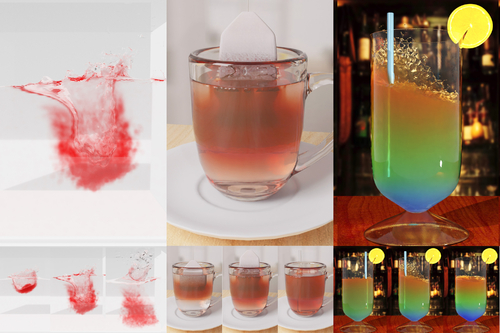
DescriptionParticle-based simulation has become increasingly popular in real-time applications due to its efficiency and adaptability, especially in generating highly dynamic fluid effects. Nevertheless, the swift and stable simulation of interactions between distinct fluids continues to pose challenges for current mixture model techniques. When using a single mixture flow field to represent all fluid phases, numerical discontinuities in phase fields can result in significant losses of dynamic effects and unstable conservation of mass and momentum.
To tackle these issues, we present an advanced implicit mixture model for smoothed particle hydrodynamics. Instead of relying on an explicit mixture field for all dynamic computations and phase transfers between particles, our approach calculates phase momentum sources from the mixture model to derive explicit, continuous velocity phase fields. We then implicitly obtain the mixture field using our proposed phase-mixture momentum mapping mechanism, ensuring the conservation of incompressibility, mass, and momentum. In addition, we propose a mixture viscosity model and establish viscous effects between the mixture and individual fluid phases to avoid instability under extreme inertia conditions.
Through a series of experiments, we show that our method effectively improves dynamic effects compared to existing mixture models while reducing critical instability factors. This makes our approach particularly well-suited for long-duration, efficiency-oriented virtual reality scenarios.
To tackle these issues, we present an advanced implicit mixture model for smoothed particle hydrodynamics. Instead of relying on an explicit mixture field for all dynamic computations and phase transfers between particles, our approach calculates phase momentum sources from the mixture model to derive explicit, continuous velocity phase fields. We then implicitly obtain the mixture field using our proposed phase-mixture momentum mapping mechanism, ensuring the conservation of incompressibility, mass, and momentum. In addition, we propose a mixture viscosity model and establish viscous effects between the mixture and individual fluid phases to avoid instability under extreme inertia conditions.
Through a series of experiments, we show that our method effectively improves dynamic effects compared to existing mixture models while reducing critical instability factors. This makes our approach particularly well-suited for long-duration, efficiency-oriented virtual reality scenarios.
Event Type
Technical Papers
TimeTuesday, 12 December 20239:30am - 12:45pm
LocationDarling Harbour Theatre, Level 2 (Convention Centre)