
SLANG.D: Fast, Modular and Differentiable Shader Programming
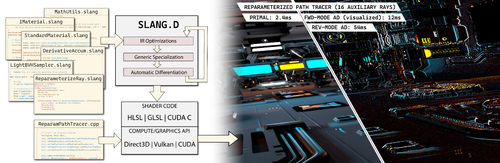
DescriptionWe introduce SLANG.D, a shading language that incorporates first-class automatic differentiation support derived from the Slang language. The new shading language allows us to transform a Direct3D-based path tracer to be fully differentiable with minor modifications to existing code. SLANG.D enables a shared ecosystem between machine learning frameworks and pre-existing graphics hardware API-based rendering systems, promoting the interchange of components and ideas across these two domains.
Our contributions include a differentiable type system designed to ensure type safety and semantic clarity in codebases that blend differentiable and non-differentiable code, language primitives that automatically generate both forward and reverse gradient propagation methods, and a compiler architecture that generates efficient derivative propagation shader code for graphics pipelines. Our compiler supports differentiating code that involves arbitrary control-flow, dynamic dispatch, generics and higher-order differentiation, while providing developers flexible control of checkpointing and gradient aggregation strategies for best performance. Our system allows us to differentiate an existing real-time path tracer, Falcor, with minimal change to its shader code.
We show that the compiler-generated derivative kernels perform as efficiently as handwritten ones. In several benchmarks, the SLANG.D code achieves significant speedup when compared to prior automatic differentiation systems.
Our contributions include a differentiable type system designed to ensure type safety and semantic clarity in codebases that blend differentiable and non-differentiable code, language primitives that automatically generate both forward and reverse gradient propagation methods, and a compiler architecture that generates efficient derivative propagation shader code for graphics pipelines. Our compiler supports differentiating code that involves arbitrary control-flow, dynamic dispatch, generics and higher-order differentiation, while providing developers flexible control of checkpointing and gradient aggregation strategies for best performance. Our system allows us to differentiate an existing real-time path tracer, Falcor, with minimal change to its shader code.
We show that the compiler-generated derivative kernels perform as efficiently as handwritten ones. In several benchmarks, the SLANG.D code achieves significant speedup when compared to prior automatic differentiation systems.

Event Type
Technical Papers
TimeTuesday, 12 December 20239:30am - 12:45pm
LocationDarling Harbour Theatre, Level 2 (Convention Centre)