
Constrained Delaunay Tetrahedrization: A Robust and Practical Approach
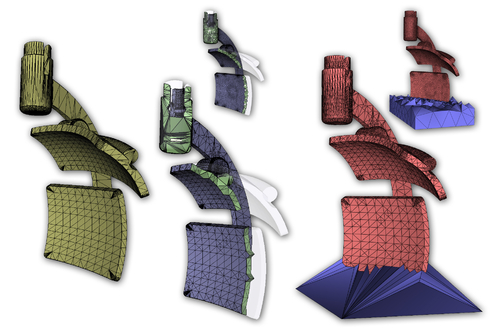
DescriptionWe present a numerically robust algorithm for computing the constrained Delaunay tetrahedrization (CDT) of a piecewise-linear complex, which has a 100% success rate on the 4408 valid models in the Thingy10k dataset.
We build on the underlying theory of the well-known tetgen software, but use a floating-point implementation based on indirect geometric predicates to implicitly represent Steiner points: this new approach dramatically simplifies the implementation, removing the need for ad-hoc tolerances in geometric operations. Our approach leads to a robust and parameter-free implementation, with an empirically manageable number of added Steiner points. Furthermore, our algorithm addresses a major gap in tetgen’s theory which may lead to algorithmic failure on valid models, even when assuming infinite precision in the calculations.
Our output tetrahedrization conforms with the input geometry without approximations. We can further round our output to floating-point coordinates for downstream applications, which almost always results in valid floating-point meshes unless the input triangulation is very close to being
degenerate.
We build on the underlying theory of the well-known tetgen software, but use a floating-point implementation based on indirect geometric predicates to implicitly represent Steiner points: this new approach dramatically simplifies the implementation, removing the need for ad-hoc tolerances in geometric operations. Our approach leads to a robust and parameter-free implementation, with an empirically manageable number of added Steiner points. Furthermore, our algorithm addresses a major gap in tetgen’s theory which may lead to algorithmic failure on valid models, even when assuming infinite precision in the calculations.
Our output tetrahedrization conforms with the input geometry without approximations. We can further round our output to floating-point coordinates for downstream applications, which almost always results in valid floating-point meshes unless the input triangulation is very close to being
degenerate.
Event Type
Technical Papers
TimeTuesday, 12 December 20239:30am - 12:45pm
LocationDarling Harbour Theatre, Level 2 (Convention Centre)