
DR-Occluder: Generating Occluders using Differentiable Rendering
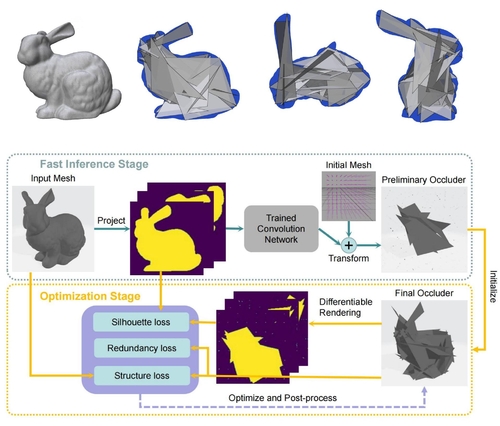
DescriptionThe target of the occluder is to use very few faces to maintain similar occlusion properties of the original 3D model.
In this paper, we present DR-Occluder, a novel coarse-to-fine framework for occluder generation that leverages differentiable rendering to optimize a triangle set to an occluder. Unlike prior work, which has not utilized differentiable rendering for this task, our approach provides the ability to optimize a 3D shape to defined targets. Given a 3D model as input, our method first projects it to silhouette images, which are then processed by a convolution network to output a group of vertex offsets. These offsets are used to transform a group of distributed triangles into a preliminary occluder, which is further optimized by differentiable rendering. Finally, triangles whose area is smaller than a threshold are removed to obtain the final occluder. Our extensive experiments demonstrate that DR-Occluder significantly outperforms state-of-the-art methods in terms of occlusion quality. Furthermore, we compare the performance of our method with other approaches in a commercial engine, providing compelling evidence of its effectiveness.
In this paper, we present DR-Occluder, a novel coarse-to-fine framework for occluder generation that leverages differentiable rendering to optimize a triangle set to an occluder. Unlike prior work, which has not utilized differentiable rendering for this task, our approach provides the ability to optimize a 3D shape to defined targets. Given a 3D model as input, our method first projects it to silhouette images, which are then processed by a convolution network to output a group of vertex offsets. These offsets are used to transform a group of distributed triangles into a preliminary occluder, which is further optimized by differentiable rendering. Finally, triangles whose area is smaller than a threshold are removed to obtain the final occluder. Our extensive experiments demonstrate that DR-Occluder significantly outperforms state-of-the-art methods in terms of occlusion quality. Furthermore, we compare the performance of our method with other approaches in a commercial engine, providing compelling evidence of its effectiveness.
Event Type
Technical Papers
TimeTuesday, 12 December 20239:30am - 12:45pm
LocationDarling Harbour Theatre, Level 2 (Convention Centre)