
LiCROM: Linear-Subspace Continuous Reduced Order Modeling with Neural Fields
DescriptionLinear reduced-order modeling (ROM) simplifies complex simulations by approximating the behavior of a system using a simplified kinematic representation. Typically, ROM
is trained on input simulations created with a specific spatial discretization,
and then serves to accelerate simulations with the same discretization.
This discretization-dependence is restrictive.
Becoming independent of a specific discretization would provide flexibility to mix and match mesh resolutions, connectivity, and type (tetrahedral, hexahedral) in training data; to
accelerate simulations with novel discretizations unseen during training;
and to accelerate adaptive simulations that temporally or parametrically change
the discretization.
We present a flexible, discretization-independent approach to reduced-order modeling.
Like traditional ROM, we represent the configuration as a linear combination of displacement
fields. Unlike traditional ROM, our displacement fields are continuous maps from every point on the reference domain to a corresponding displacement vector; these maps are
represented as implicit neural fields.
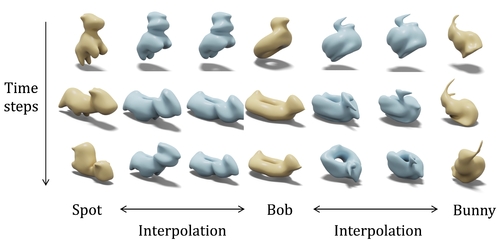
With linear continuous ROM (LiCROM), our training set can include multiple geometries undergoing multiple loading conditions, independent of their discretization. This opens the door to novel applications of reduced order modeling. For instance, we can accelerate
simulations on geometries unseen during training, and simulations that modify the geometry at runtime, for instance via cutting, hole punching, and even swapping the entire mesh. Indeed, we achieve one-shot generalization by training on a single geometry but testing on multiple unseen geometries.
is trained on input simulations created with a specific spatial discretization,
and then serves to accelerate simulations with the same discretization.
This discretization-dependence is restrictive.
Becoming independent of a specific discretization would provide flexibility to mix and match mesh resolutions, connectivity, and type (tetrahedral, hexahedral) in training data; to
accelerate simulations with novel discretizations unseen during training;
and to accelerate adaptive simulations that temporally or parametrically change
the discretization.
We present a flexible, discretization-independent approach to reduced-order modeling.
Like traditional ROM, we represent the configuration as a linear combination of displacement
fields. Unlike traditional ROM, our displacement fields are continuous maps from every point on the reference domain to a corresponding displacement vector; these maps are
represented as implicit neural fields.
With linear continuous ROM (LiCROM), our training set can include multiple geometries undergoing multiple loading conditions, independent of their discretization. This opens the door to novel applications of reduced order modeling. For instance, we can accelerate
simulations on geometries unseen during training, and simulations that modify the geometry at runtime, for instance via cutting, hole punching, and even swapping the entire mesh. Indeed, we achieve one-shot generalization by training on a single geometry but testing on multiple unseen geometries.


Event Type
Technical Papers
TimeTuesday, 12 December 20239:30am - 12:45pm
LocationDarling Harbour Theatre, Level 2 (Convention Centre)