
Neural Metamaterial Networks for Nonlinear Material Design
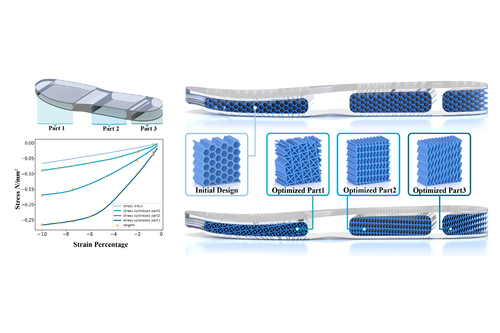
DescriptionNonlinear metamaterials with tailored mechanical properties have applications in engineering, medicine, robotics, and beyond. While modeling
their macromechanical behavior is challenging in itself, finding structure
parameters that lead to an ideal approximation of high-level performance goals
is a daunting task. In this work, we propose Neural Metamaterial Networks
(NMN)—smooth neural representations that encode the nonlinear mechanics of entire metamaterial families. Given structure parameters as input,
NMN return continuously differentiable strain energy density functions,
thus guaranteeing conservative forces by construction. Though trained on
simulation data, NMN do not inherit the discontinuities resulting from topological changes in finite element meshes. They instead provide a smooth
map from parameter to performance space that is fully differentiable and
thus well-suited for gradient-based optimization. On this basis, we formulate
inverse material design as a nonlinear programming problem that leverages
neural networks for both objective functions and constraints. We use this
approach to automatically design materials with desired strain-stress curves,
prescribed directional stiffness, and Poisson ratio profiles. We furthermore
conduct ablation studies on network nonlinearities and show the advantages
of our approach compared to native-scale optimization.
their macromechanical behavior is challenging in itself, finding structure
parameters that lead to an ideal approximation of high-level performance goals
is a daunting task. In this work, we propose Neural Metamaterial Networks
(NMN)—smooth neural representations that encode the nonlinear mechanics of entire metamaterial families. Given structure parameters as input,
NMN return continuously differentiable strain energy density functions,
thus guaranteeing conservative forces by construction. Though trained on
simulation data, NMN do not inherit the discontinuities resulting from topological changes in finite element meshes. They instead provide a smooth
map from parameter to performance space that is fully differentiable and
thus well-suited for gradient-based optimization. On this basis, we formulate
inverse material design as a nonlinear programming problem that leverages
neural networks for both objective functions and constraints. We use this
approach to automatically design materials with desired strain-stress curves,
prescribed directional stiffness, and Poisson ratio profiles. We furthermore
conduct ablation studies on network nonlinearities and show the advantages
of our approach compared to native-scale optimization.
Event Type
Technical Papers
TimeTuesday, 12 December 20239:30am - 12:45pm
LocationDarling Harbour Theatre, Level 2 (Convention Centre)